
HR and payroll software for South Africa that does not stop at the org chart
Most HR systems stop at the org chart. HRify is HR and payroll software for South African employers that keeps going: the same login that onboards a new hire runs your SARS payroll, tracks the CCMA clock on a disciplinary case, and invoices a client for the hours someone logged. Twenty-one modules, one set of approvals, one record of who did what. In rand, against South African law.
A South African employer of 10 to 250 people is often running all of this at once:
Six systems that do not talk to each other, and somebody in the middle reconciling them by hand every month. HRify is one login across the lot.
Built for every seat in the business
The people who feel the gaps between those systems are usually the HR manager, the financial manager, or the owner doing the reconciliation personally.
HR managers
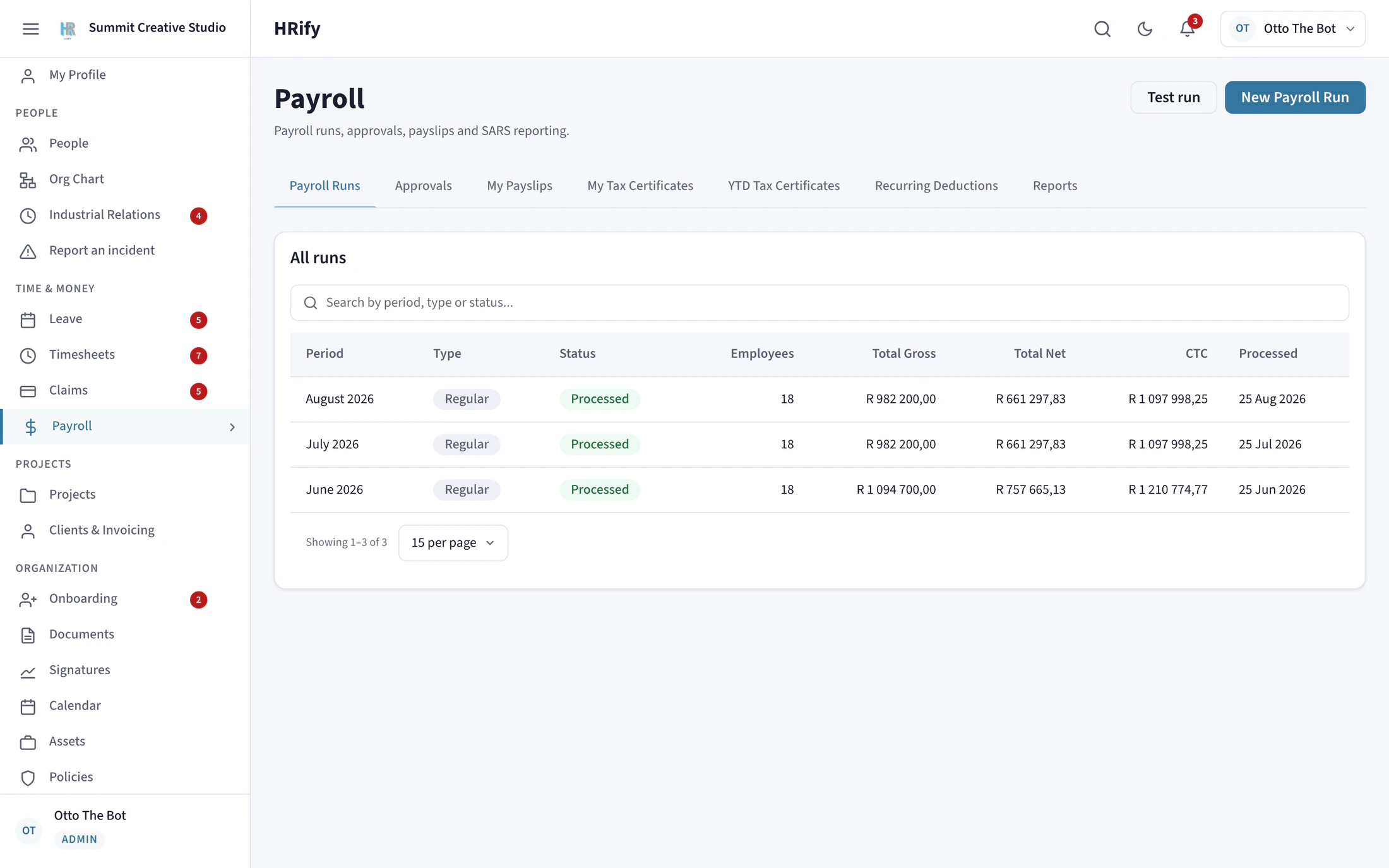
Hiring, onboarding, leave, reviews and discipline in one record per person, with the statutory paperwork generated from it, not filled in off a template.
Financial managers
Run payroll in-house, check it against SARS rules before you file, and bill clients from the hours your team actually logged.
Managers
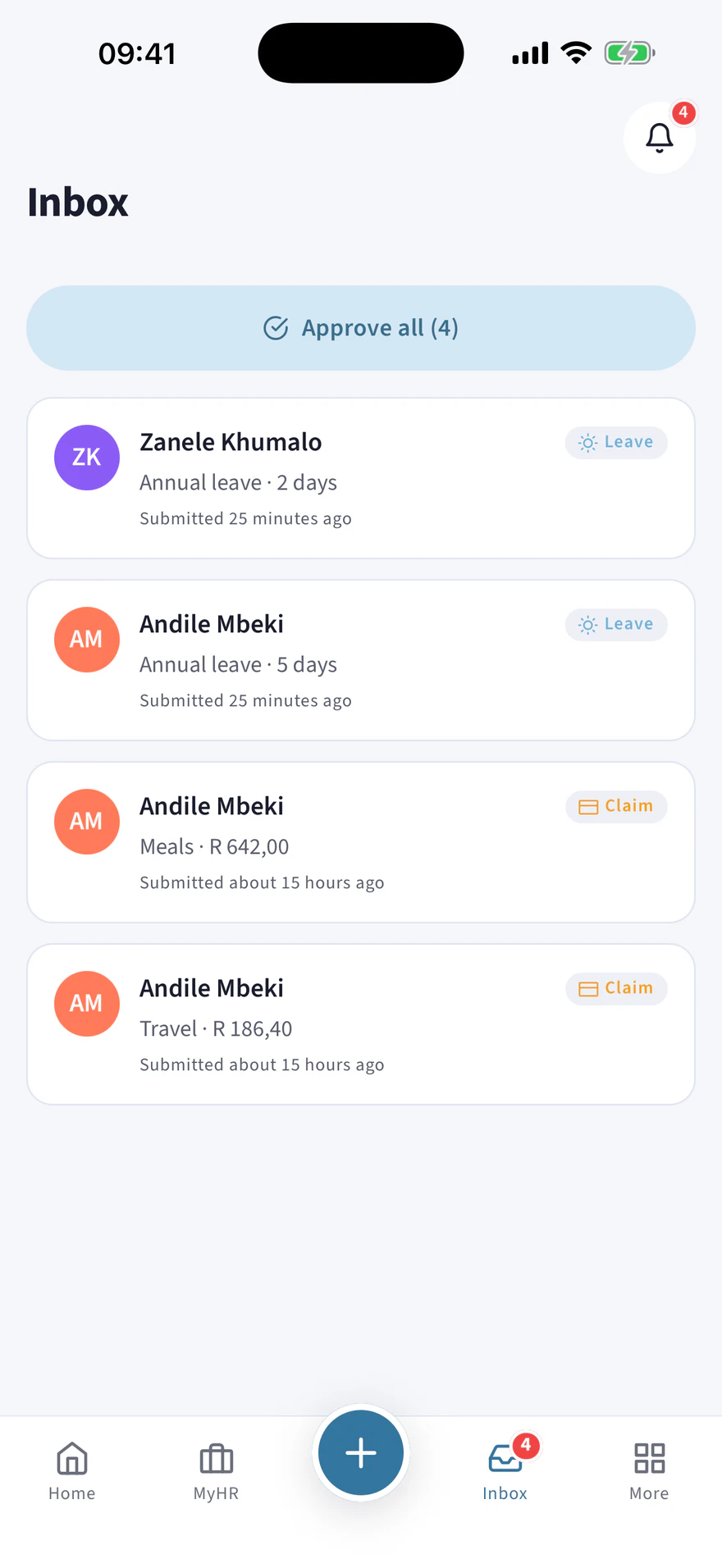
Leave, timesheets and claims in one queue, not three inboxes. Approve a batch at your desk, or swipe through them on your phone.
Everyone else
Apply for leave, log time, photograph a receipt, read a payslip, sign a policy. Without emailing HR to ask how many days they have left.
Twenty-one modules, grouped the way the product is
Everything below is in the product today, in the order you will find it in the menu.
Main
- 01Analytics
Headcount, turnover, leave, payroll and hiring, by department, over six to twenty-four months.
People
- 02PeopleIncluded
Employee records, org chart, departments and reporting lines. Bank-detail changes need a second person to approve them.
- 03Industrial Relations
Cases, suspensions, hearings, appeals, improvement plans, warnings and retrenchment, with the letters they require.
Time & Money
- 04Leave
Every statutory leave type, with sick leave on a 36-month cycle counted from each person’s own start date.
- 05Timesheets
Weekly capture against projects, a live timer, and overtime approved separately.
- 06Claims
Expenses with receipts, plus the six allowance types SARS taxes differently.
- 07Payroll
Pay runs, payslips, a bank file to upload, and the SARS set: IRP5, EMP201, EMP501 and tax directives.
Projects
- 08Projects
Boards, sprints, tickets and releases, with a cost and a billing rate against each one.
- 09Clients & Invoicing
Invoices, estimates and credit notes billed from approved hours, signed by the client through a link.
Organisation
- 10Onboarding
A checklist per hire covering tasks, documents, equipment and a buddy. Offboarding runs it in reverse.
- 11DocumentsIncluded
A company library where who sees what is set per document.
- 12Assets
What the company owns, who is holding it, and when it was last serviced.
- 13Policies
Published policies with a record of who has acknowledged them, and reminders for who has not.
- 14CalendarIncluded
Company events with RSVPs, plus every South African public holiday.
Talent
- 15Recruitment
Adverts, a candidate pipeline, interview scorecards, and offers signed without a login.
- 16Benefits
Programmes, tiers and enrolment, each priced on the payslip with the right tax treatment.
- 17Compensation
Salary bands, increase cycles and promotions, with pay-gap and band analysis.
- 18KPIs & Reviews
Review cycles with self-assessment, manager review and project feedback.
- 19Succession
Critical roles, a nine-box grid, and a flag on any role with nobody ready to step in.
- 20Learning
Courses, enrolment, quizzes and certificates, producing your WSP/ATR figures.
Engagement
- 21Engagement
Surveys, peer recognition, action plans, and a suggestion box staff can upvote.
People, Documents and Calendar are included on every plan. Every other module reads from the employee record.
A screen for every part of the job
Captured from the live product, not a mock-up. The list below is the menu your team would see.
Main
People
Time & Money
Projects
Organisation
Talent
Engagement
Admin
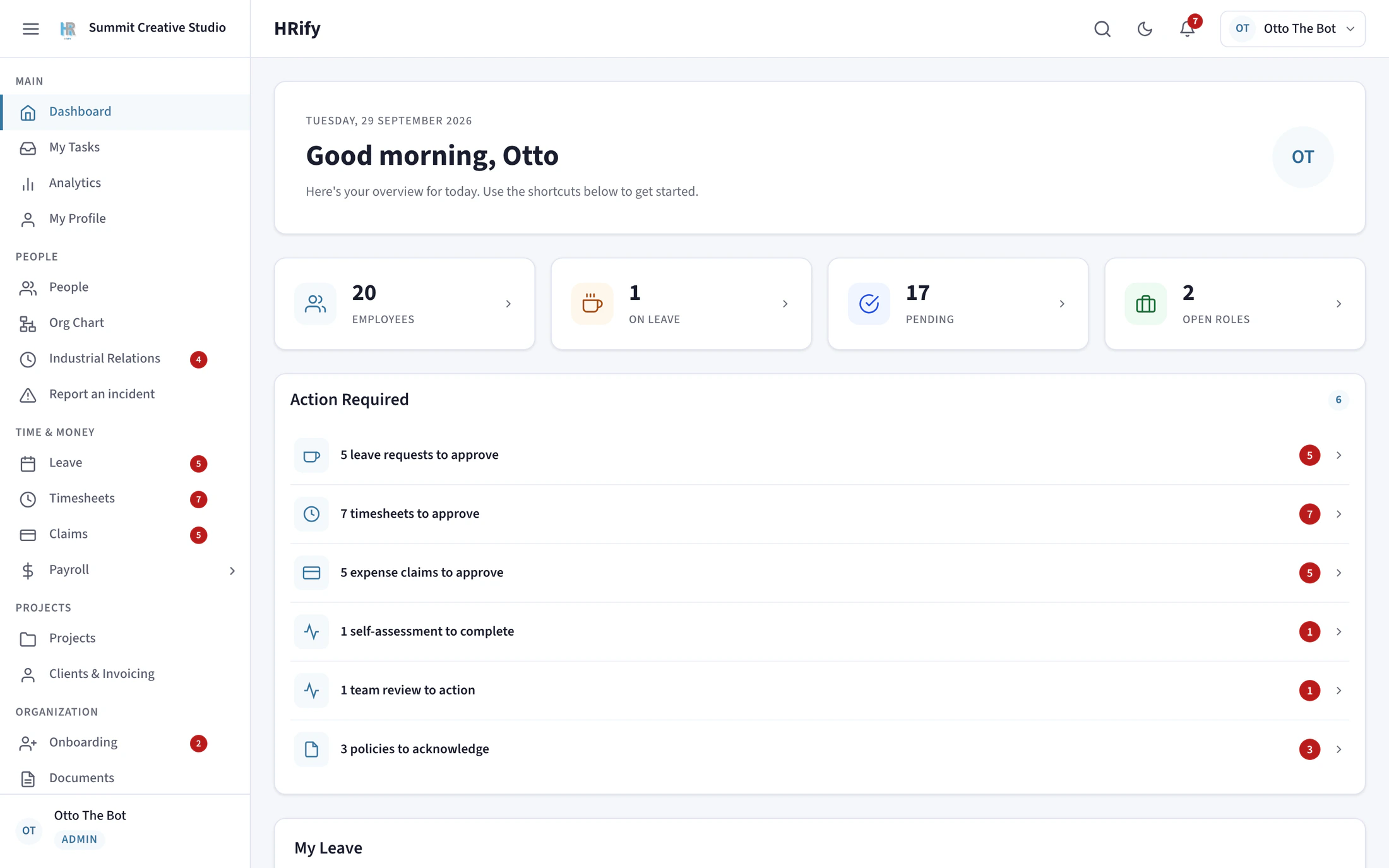
Dashboard
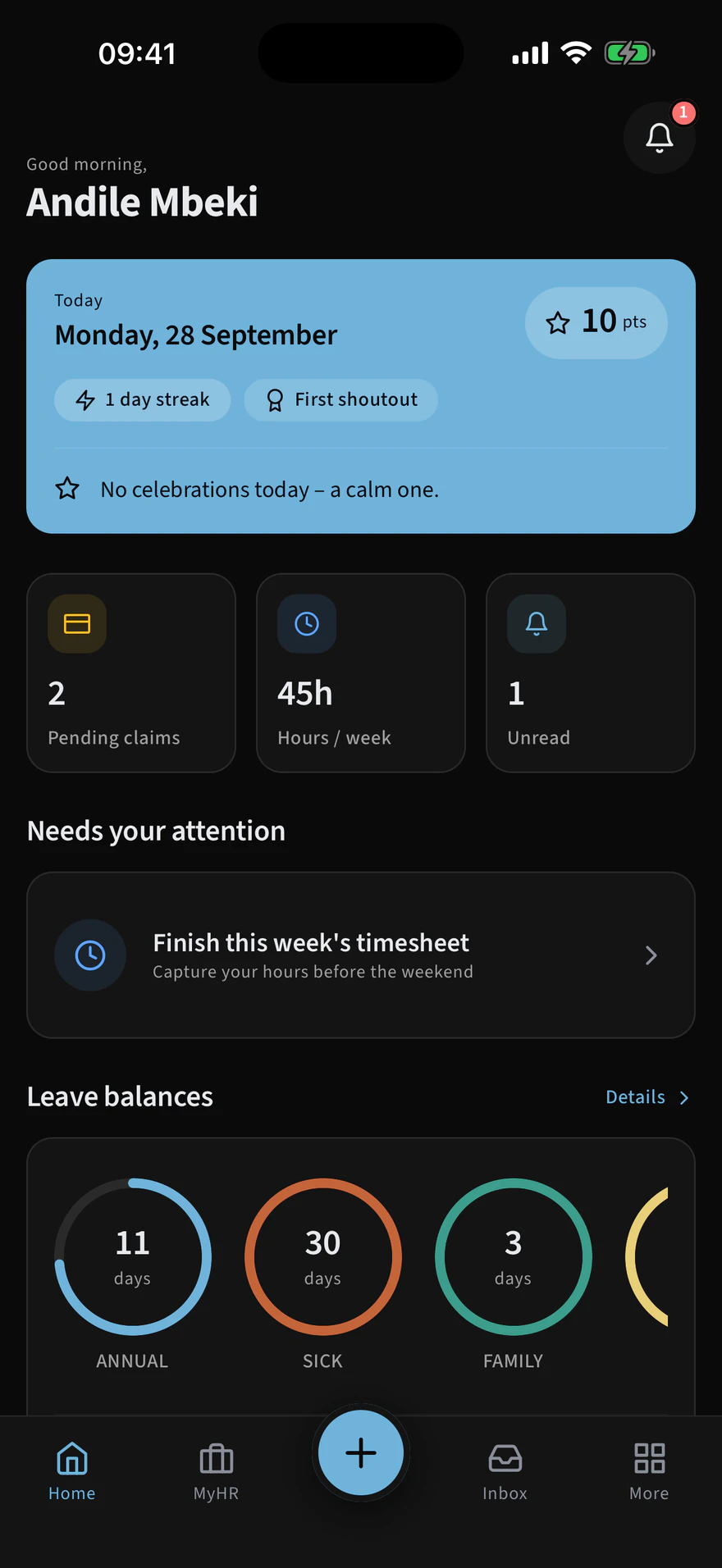
Everyone lands on what is waiting for them. Leave, timesheets and claims to approve, reviews to complete, policies to sign, onboarding tasks, and a reminder if their own timesheet is still open. Leave balances, who is out today, new joiners and upcoming public holidays sit below it.
The compliance is the product, not a settings page
Global HR software localises by adding a currency symbol and a tax field. This was built for one country, which is why the leave engine knows what a 36-month sick cycle is and a disciplinary case starts a CCMA clock.
Run payroll in-house and have SARS accept it
- Produces the e@syFile import file for your certificates, and the bulk file for registering employees who do not have a tax number yet.
- Before you export anything, a validator runs SARS's own rules over every employee and tells you by name who will fail and why.
- Monthly EMP201, EMP501 at reconciliation, and IRP5 and IT3(a) certificates. The ETI carry-forward is calculated for you.
- Tax directives, severance, back pay, bursaries, company cars and share schemes are handled as proper taxable events instead of manual adjustments someone has to remember.
- Earnings and deductions map to the right SARS source codes, and anything out of scope is listed up front, never quietly left off a certificate.
- Two tax years are loaded from the Government Gazette. If a figure has not been published yet, payroll stops instead of guessing.
HRify produces the file and the figures. You import into e@syFile and file the return.
Leave and hours that match the Act
- Every statutory leave type, with sick leave on a 36-month cycle counted from each employee's own start date, not a company-wide reset.
- Carry-over expires when the Act says it does, and you cannot pay out more than section 20(11) allows.
- Approving a timesheet checks that week against daily and weekly hour limits, the overtime ceiling, meal breaks, night work and the earnings threshold, and warns you before you commit.
- Overtime at 1.5×, Sundays and public holidays at 2×. A Sunday overtime hour pays 2× and not 3.5×, because the hours are not counted twice.
- Minimum wage is checked against the gazetted figure for that period, not last year's.
- When someone leaves, the section 42 certificate of service and the UI-19 come out of their record.
You hold ID numbers and bank details. This treats them that way.
- ID, passport and tax numbers, bank accounts, medical aid details and signatures are encrypted in the database, not just hidden behind a login.
- Retention is set per category of record, and HRify will not let you choose a period shorter than the law allows: five years for tax records, three for BCEA, four for COIDA.
- Deleting an employee anonymises them. Their identity clears, the payroll and audit history stays, because SARS still requires it.
- If something still legally needs that record, the deletion is refused and you are told exactly what is holding it and until when.
- When someone asks what you hold on them, the export is built for you, with any other person's details in a shared record stripped out.
A disciplinary case with the clock already running
- Written against the 2025 Code of Good Practice on Dismissal, which replaced Schedule 8 in September that year.
- You cannot record a dismissal against a case that never had a hearing.
- The referral window is counted from the right date. A dismissal on notice starts the clock when the notice period ends, an internal appeal restarts it, and a deadline falling on a weekend rolls to the next working day.
- Thirty days for a dismissal, ninety for an unfair labour practice, chosen by the sanction, not by how someone filed the case.
- Hearing notices, outcome letters and dismissal letters generate as signed PDFs off the case itself.
- Retrenchment follows section 189A, with the nine consultation headings checked off and severance compared against what you are offering.
Every product says “compliant”. Ask to see it stop you.
A checklist is easy to claim. These are the points where HRify refuses to carry on, and each one is a penalty, a CCMA award or a SARS query that did not happen.
Filing a SARS submission with errors in it. The validator names the employees and the reasons. A test export still runs, so you can see the whole list before fixing anything.
Running payroll into a tax year nobody has checked. On 1 March it flags the figures that change and waits for someone to confirm them.
Paying a lump sum SARS has not priced yet. Severance and certain other payments wait for the directive, so nothing goes out and has to be corrected later.
Deleting an employee the law says you must keep. You are told which records still need them and for how long.
Approving your own claim, payroll run or bank-detail change. Not a setting an administrator can quietly switch off.
Issuing the same invoice number twice. Under the VAT Act that has to fail rather than repeat, so it fails.
Ten things need signing off. They all work the same way.
Payroll, leave, claims, timesheets, severance, back pay, tax directives, salary advances, share schemes and bank-detail changes run through one approval chain you configure once.
Your chain, per module
Decide who approves what, in what order, and whether a step can be handed to someone else. Leave can be one signature and payroll can be three.
Nobody approves their own money
On claims, payroll, severance, back pay, advances and bank-detail changes, the person who raised it cannot be the one to approve it. Leave joins that list the moment it is being paid out instead of taken.
Leave does not stall the business
If an approver is away when something is submitted, HRify offers a stand-in at the same level who is not also away. Approvals keep moving while people are on holiday.
And the person who was away keeps their say
When they are back they can still overturn the decision or send the case back a step, even though someone stood in for them.
Sent back is not the same as declined
Returning something for rework puts it back an earlier step and clears the later sign-offs. Declining it closes the matter. Both require a reason, so the record explains itself later.
Caught before it commits, not after
Leave balances, the waiting period on a bank-detail change and self-approved timesheets are checked before the final approval goes through, so a problem stops the decision instead of having to be undone.
Otto answers questions about your own people
Ask in plain language instead of building a report. Otto reads your live HR data and answers questions about headcount, leave, timesheets, claims, payroll, hiring, training and pending approvals. Staff can ask about their own leave, payslips and claims without opening a ticket with HR.
It can answer, not change
Otto has no way to write to your data. It cannot approve, edit or delete anything.
It only sees what you see
A manager asking about leave gets their own team, not the company. An employee gets themselves.
Off until you switch it on, and priced by the question
Turning it on is a deliberate POPIA decision, and it is charged as a monthly allowance of questions rather than per seat. ID numbers, bank details, employment equity and medical aid data are never sent to it.
Who is on leave next week?
Four people are on approved leave next week: two in Engineering, one in Finance and one in Operations. Wednesday is the thin day, with three of them out at once.
Two more requests for that same week are still with you for approval, so the number could still change.
Otto is AI and can make mistakes. Check anything you act on.
Your team will not use software they have to sit down for
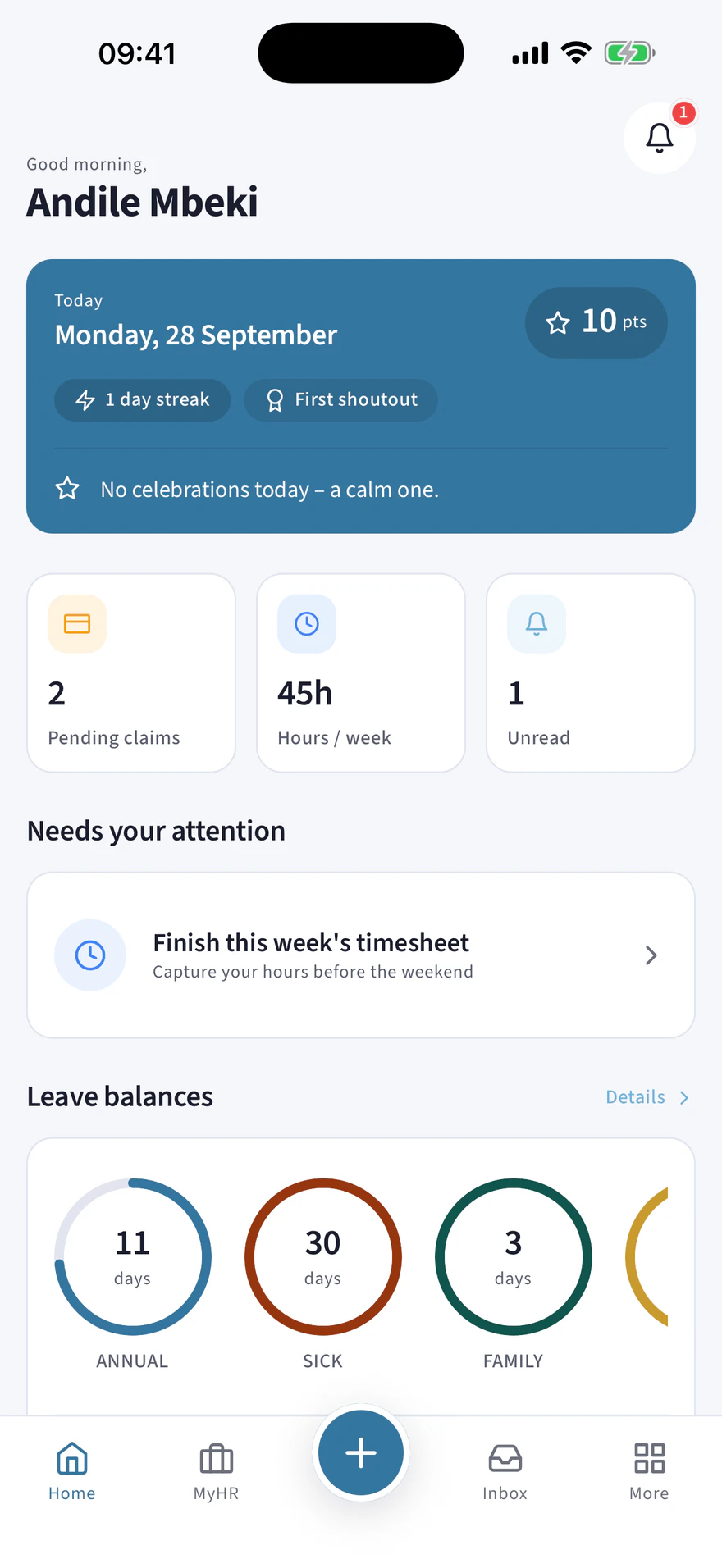
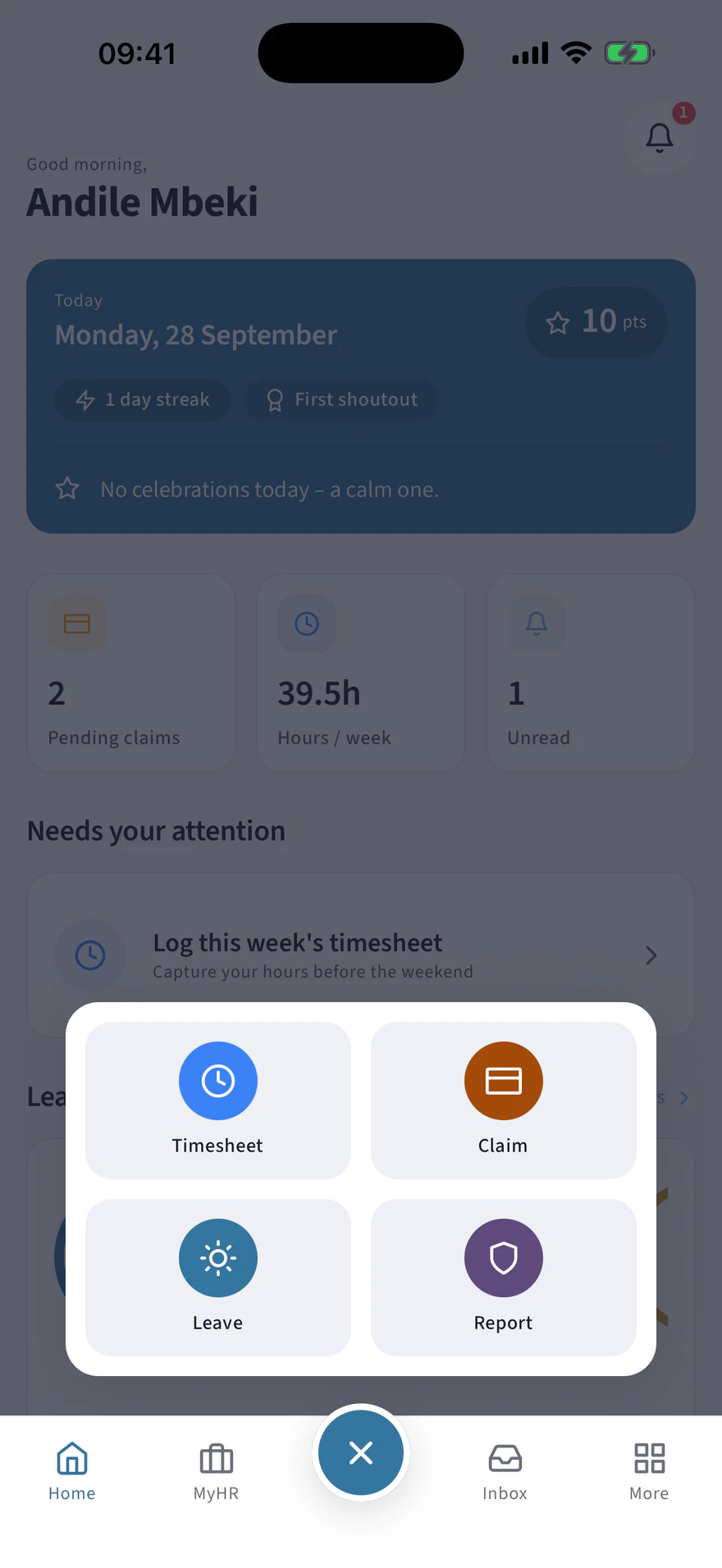
A proper iOS and Android app, not a website in a frame. Four tabs and a centre button that opens the four things people do most: leave, a timesheet, a claim, or report an incident.
The HR queries that never reach you
- Apply for leave with a doctor's note attached, fill in a week's timesheet, or run a timer while working.
- Photograph a receipt and submit the claim on the spot, instead of finding it in a jacket pocket at month-end.
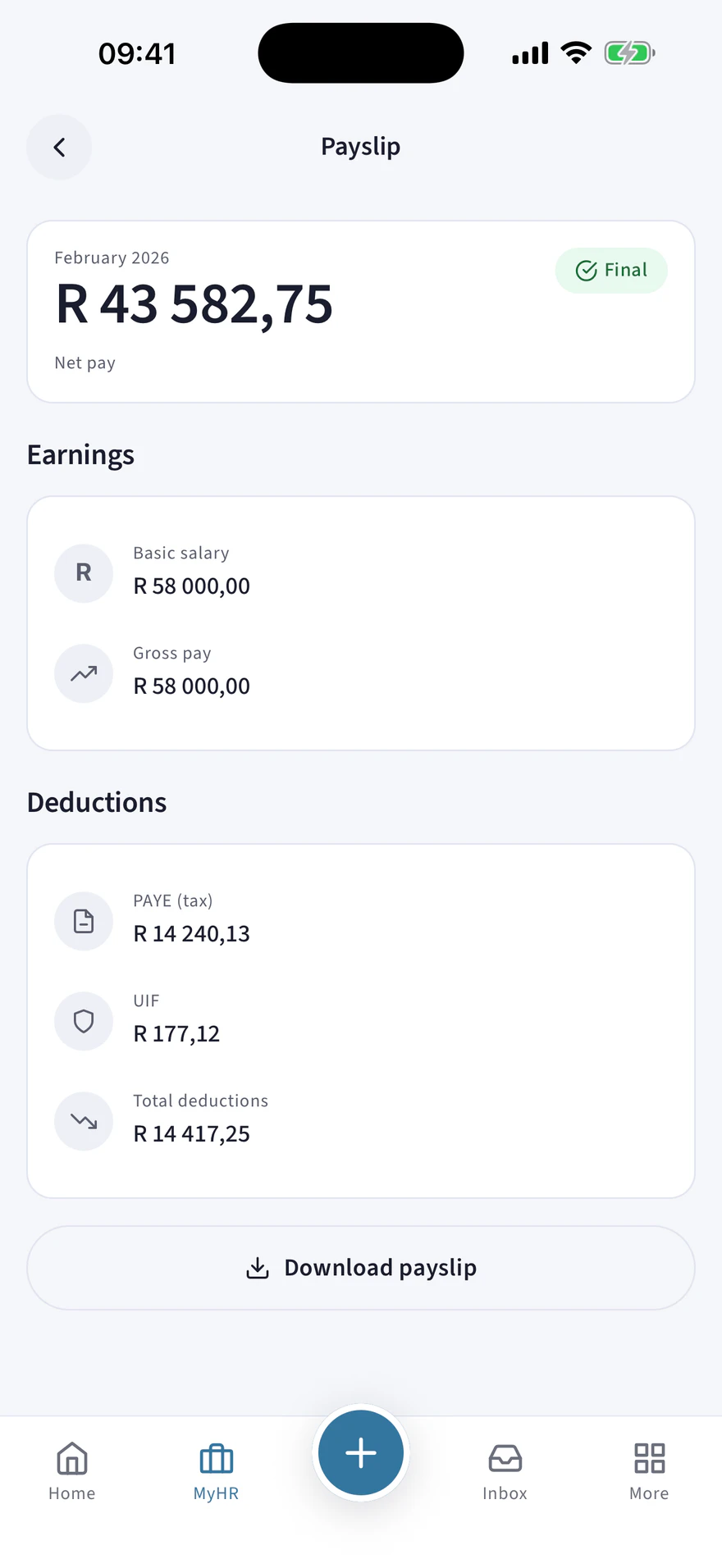
- Read a payslip with the full breakdown, hide the net pay with a tap when someone is looking over a shoulder, and download the PDF for a landlord or a bank.
- Look up a colleague, see the org chart, see company events and public holidays, read and sign a policy, give someone recognition, answer a survey.
- Report an incident, anonymously if they choose, with a reference they can follow without identifying themselves.
- Managers approve leave, timesheets and claims from one queue. Swipe right to approve, left to decline, or clear the lot at once.
If a phone is lost, nothing walks out with it
- The app locks behind Face ID or a fingerprint by default, and falls back to the phone's passcode so a device with only a PIN is still protected.
- Screenshots and screen recording are blocked on the screens that show money, health, disciplinary or identity information, and the app blurs itself in the app switcher.
- Notifications never carry their contents. A push says a leave request needs review, not whose or for what.
- Disciplinary and payroll notifications do not push at all, because the subject line alone would tell someone too much.
- Downloaded payslips are cleared from the phone on a timer and wiped when the person signs out.
- Microsoft 365 sign-in and two-factor authentication are both supported.
Who can see what
An HR system holds the most sensitive information in the business. Most of the work here went into who does not see it.
Managers see less than you would expect
A manager looking at one of their own team gets no ID number, bank details, date of birth, medical aid, employment equity data, performance rating or signature. Those fields are not masked to the last four digits, they are not sent at all. Approving someone's leave does not require knowing where they bank.
One login, more than one employer
Identity and employment are kept apart, so the same person can be an administrator at their own company and a manager at a client. An external accountant or HR consultant needs one account, not one per client, and removing their access takes effect immediately, not whenever they next sign in.
Two-factor you can insist on
You can require two-step verification for particular roles, so everyone with payroll access has it whether they got around to setting it up or not. It applies when they sign in, when they use Microsoft 365, and when their session renews.
Things that happen without anyone remembering
An increase dated for next month is applied before that payroll runs. Leave accrues monthly. CCMA deadlines and warning expiries chase themselves. Timesheet reminders go out on a Friday. Invoices chase late payers. None of it depends on someone having it in their diary.
The market splits three ways. HRify spans all three.
Two applications over one system: a web app for administrators, managers and finance, and a mobile app for everyone else. Both see the same data at the same time.
Priced per employee, per month, in rand
Tiers are cumulative: each one includes everything below it. All prices exclude VAT.
per employee, per month
Minimum R790 a month
HR without payroll. Everything you need to run the people side properly.
- People and employee records
- Leave, BCEA-aligned
- Documents, policies and signatures
- Onboarding and offboarding
- Calendar and company events
- Self-service on web and mobile
per employee, per month
Minimum R1,490 a month
Everything in Starter, plus the payroll and the SARS paperwork that goes with it.
- Payroll and SARS: EMP201, EMP501, ETI
- Tax directives, severance and back pay
- Timesheets, live timer and claims
- Recruitment, KPI reviews and analytics
- Learning, bursaries and engagement
- The approval workflow engine
per employee, per month
Minimum R2,290 a month
Everything in Professional, plus industrial relations and the billable side of the business.
- Industrial relations and CCMA tracking
- Incidents and injuries on duty
- Projects, sprints and kanban
- Clients, invoicing and recurring billing
- Compensation and succession
- POPIA, Employment Equity, WSP and COIDA
Count everyone with an active employee record in a month, including part-time staff.
- Starter–a month
- ProfessionalRecommended–a month
- Business–a month
Above 300 employees, HRify is priced on your own numbers. Ask us for a quote.
This is an estimate on monthly billing, before any annual discount and excluding VAT. We confirm your exact price in a written quote.
Card prices are the rate up to 100 staff. Each tier has a monthly minimum, so a small team pays the minimum rather than the per-employee total. Every employee above 100 is charged less: R46, R89 and R125, while the first 100 stay at the card rate. Above 300 staff, the price is quoted on your own numbers. Annual billing is 15% off, locks the rate for twelve months and waives implementation. Two-factor authentication and biometric unlock are included in every tier, because security is never an upsell.
Questions about HRify, answered plainly
The things people ask before a demo. If yours is not here, ask us on WhatsApp.
Is HRify SARS compliant?
HRify runs payroll to SARS rules and produces the monthly EMP201 figures, the EMP501 at reconciliation, IRP5 and IT3(a) certificates and the e@syFile import file. Before you export, a validator runs SARS’s own rules over every employee and names anyone who will fail. There is no SARS certification for payroll software, and HRify does not file for you: you import into e@syFile and submit the return.
How much does HRify cost?
HRify is priced per employee, per month, in rand, excluding VAT. Starter is R52 with a minimum of R790 a month, Professional is R99 with a minimum of R1,490, and Business is R139 with a minimum of R2,290. Those are the rates up to 100 staff. Employees above 100 are charged less, and above 300 we quote on your own numbers. Annual billing is 15% off and waives implementation.
Does HRify handle leave under the BCEA?
Yes. Every statutory leave type is built in, with sick leave on a 36-month cycle counted from each employee’s own start date. Carry-over expires when the Act says it does, an employee is told they are short before they submit, and every South African public holiday feeds the calculation.
Is payroll part of HRify or a separate product?
Payroll is part of the platform from the Professional tier up. It reads approved leave, timesheets and claims from the same employee record, so there is no export from an HR system into a payroll engine and nothing to reconcile between the two.
Is there an HRify mobile app?
Yes, an iOS and Android app. Staff apply for leave, log time, photograph a receipt for a claim, read payslips and sign policies. Managers approve leave, timesheets and claims from one queue. The app locks behind Face ID or a fingerprint, and the screens that show money or identity block screenshots.
Who is HRify for?
South African employers of roughly 10 to 250 people who want HR, payroll, and often projects and client invoicing, under one login. The person who usually brings it in is the HR manager, the financial manager, or the owner doing the month-end reconciliation personally.
Can HRify run disciplinary cases and CCMA deadlines?
Yes. Industrial relations is included from the Business tier. Cases, warnings, hearings and appeals carry the paperwork they need, the referral window is counted from the correct date, and hearing, outcome and dismissal letters generate as signed PDFs off the case.
Can we see HRify on our own payroll before deciding?
Yes. Bring a month you have already run and watch the validator go through your own people, one by one. Request a demo and we will set it up.
Vehicles and field teams as well? That is the other platform.
OPSEN is built and run by the same team, and when neither platform fits we build the custom software that does.
OPSEN: Fleet & Operations Software
Trips, live tracking off the driver’s phone, job cards, inspections, fuel and invoicing, priced per company.
See OPSENCustom Software Development
Internal tools, customer portals, integrations and reporting, scoped in writing and supported after launch.
See Custom SoftwareWebsite Design
Fast, phone-first business websites that tell a visitor what you do and how to get hold of you.
See Website Design